Showing posts with label Transportation. Show all posts

Sunday, May 5, 2019

Shanghai Pudong International Airport

Updated:2017-07-19
Shanghai Pudong International Airport has two passenger terminals with an annual capacity of 66 million passengers, along with a cargo throughput of 3.44 million tons. 
1500452490448073133.jpg
The airport is the main hub for China Eastern Airlines and Shanghai Airlines, and a major international hub for Air China. It is also the hub for the privately-owned Juneyao Airlines and Spring Airlines, and an Asian-Pacific cargo hub for UPS and DHL.
1500452499580063376.jpg
For details on arrivals and departures, please call +86-96990 or visit the website: http://en.shairport.com/pudongair.html.
Real-time flights
http://en.shairport.com/pdquery.html
Useful numbers
Inquiry : +86-96990
Luggage
T1:+86-21-68346324
T2: +86-21-68340076
Lost and found
T1: +86-21-68346324 
T2: +86-21-68340417
Safety check
New luggage regulations permit passengers to carry one piece of luggage only. This regulation applies to all airports in China. For the size and weight limits for luggage, please consult relevant airlines.
Getting to and from Pudong Airport
Pudong Airport is about 30 kilometers away from downtown Shanghai, an hour’s drive from People's Square. There are several forms of transportation, including airport shuttle buses, the maglev and the metro line 2.
By airport shuttle bus
Eight airport bus lines from Pudong International Airport serve passengers to destinations such as People's Square, Jing'an Temple, Xujiahui, Shanghai and Pudong railway stations, and Hongqiao International Airport.
The buses are labelled "机场X线" (Airport Bus Line X) and typically operate every 15 to 30 minutes. The bus ticket fees range from 2 to 22 yuan.
There are also long distance coaches that can take people to neighboring provinces and cities, such as Suzhou and Hangzhou, and a hotel shuttle bus that goes directly to hotels downtown.
By maglev
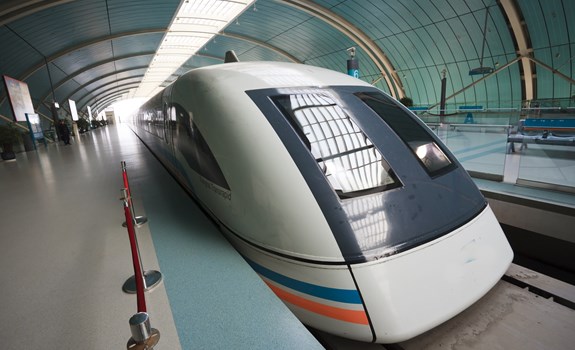
Maglev trains levitate above the tracks and are propelled forward by electromagnetic force. The levitation means trains can reach up to 500 kilometers per hour with an exceptionally smooth ride. 
Starting operation on January 29, 2004 as the first commercial high-speed maglev railway in the world, the Shanghai Maglev Train links Pudong International Airport with Longyang Road Metro Station, a transfer to Line 2 and Line 7. The 30-kilometer ride from Longyang Road Metro station to Pudong International Airport takes less than eight minutes, with the maximum speed reaching 431 kilometers per hour. The maglev trains operate every 15 minutes.
A standard one-way ticket costs 50 yuan and is valid for the whole day, and a round-trip ticket valid within 7 days cost 80 yuan. VIP tickets cost 100 yuan (single-trip) or 160 yuan (round-trip within 7 days) are also available.
Maglev train information

Operation time
6:45am-9:40pm

First train
Longyang Rd. Station
6:45am

Airport Station
7:02am

Last train
Longyang Rd. Station
9:40pm

Airport Station
9:42pm

Interval
6:45am-5pm
every 15 mins.

5pm-9:40pm
every 20 mins.


Max speed
6:45am-8:45am
300km/h

9am-10:45am
430km/h

11am-12:45pm
300km/h

1pm-4:45pm
430km/h

5am-9:40pm
300km/h


By Shanghai Metro 
Shanghai Metro Line 2 runs through stations including Pudong International Airport, Longyang Road, Lujiazui Financial Zone, People's Square and Shanghai Hongqiao International Airport. The ticket prices vary from 3 to 10 yuan according to the number of station.
Pudong Terminal 1
4.jpg
Terminal 1 was opened on October 1, 1999 along with a 4,000-meter runway and a cargo hub. The exterior of the terminal is wave-shaped. It was built to handle and relieve the rising traffic at Shanghai Hongqiao International Airport. The annual capacity of Terminal 1 is 20 million passengers and it now has 204 check-in counters, 13 luggage conveying belts, covering an area of 280,000 square meters.
Pudong Terminal 2 
5.jpg
Terminal 2 was opened on 26 March, 2008. Larger than Terminal 1, it has a similar design style as Terminal 1.
The new building has four floors. The third floor is reserved for international departures, the second floor for domestic departures and the ground floor for luggage claims. The fourth floor provides dining and shopping services, along with hourly-charged hotel rooms and gym facilities. Toilets, baby-care rooms and smoking areas are available on all floors of Terminal 2.
International transit passengers who don't need to claim luggage can go to any of the nine service desks to complete transfer procedures and then move to their departure areas after security checks.
Passengers with special needs
Passengers with special needs can be well served at Shanghai airports. In addition to elevators and ramps facilitating wheelchair users, the airport is also equipped with TDD telephones and handicapped toilets at several locations.
The 'Kind Help Passage’ can ease the process of checking in and navigating around the airport for the elderly (above 70 years old), pregnant women and the disabled. They can help with tickets, security checks, immigration, customs and boarding procedures at your request. 
However, they are unable to provide wheelchairs. If you require a wheelchair you should ask the airline with which you're flying if they can provide one.
For seniors (70 years and above), pregnant and disabled passengers, Pudong Airport offers free pushcart services, and these passengers can prioritize check-in, security check and boarding. 
Please go to the information counter of the airport for such services. To request this service go to information points on floor 3 of Terminal 2.  
6.jpg 
Pudong Airport Arrival
Terminal 1
 7.jpg
Terminal 2
 8.jpg
Pudong Airport Transfer
Terminal 1
 9.jpg
Terminal 2
10.jpg

Getting Around Shanghai

At first, Shanghai can feel overwhelming. Uprooting and travelling over multiple time zones is a strain on the constitution. To have to then navigate a gigantic, crowded and confusing city in a foreign language is altogether exhausting. We help you to travel around Shanghai on public transport with our helpful guide.

Arrival

Most international flights arrive at shiny new Pudong International Airport (PVG), located 30 km (18 miles) outside the city proper. A taxi to downtown Shanghai will cost about RMB 180 and take 45-60 minutes. Ignore the touts: they will charge you three times the rate.
Alternatively, the lightning-fast German-engineered Maglev train connects the airport with Longyang Lu Metro Station in Pudong. The 21 km (12 mile) journey only takes seven minutes, but on arrival you are still a 30-minute taxi or Metro ride from downtown Shanghai – and this is inconvenient with heavy luggage. Maglev tickets cost RMB 50. See www.shairport.com for more information.

Orientation

For the first few weeks – even months – it’s a good idea to carry a street and Metro map around. Shanghai is not a grid, and the sporadic maze of alleys, streets, boulevards and freeways is difficult to navigate, even for the city’s seasoned veterans. Morning and evening rush-hour traffic is characterised by dense, aggressive traffic and frequent gridlock. To avoid culture shock in Shanghai, we recommend using all the public transport available to you before you use a private driver in China.
Despite the massive size of greater Shanghai, most of the central areas are grouped together and manageable in size. Once inside a neighbourhood, getting around on foot is relatively easy. Central Shanghai is surrounded by one principal ring road, Zhongshan Lu, which links Puxi to Pudong via the Nanpu Bridge. The city is bisected by Yan’an Lu, an elevated freeway lit at night by red and blue neon. The elevated freeway dividing the city up and down is Gonghe Xin Lu / Chongqing Nan Lu. The most important ground level streets are Huaihai Lu and Nanjing Lu, which are both major shopping streets. Fuxing Lu, which is parallel to these, cuts through the heart of Puxi and leads into the Fuxing Tunnel that runs under the Huangpu River into the financial district of Lujiazui in Pudong. All street signs are written in both Chinese and pinyin (phonetically romanised Chinese). The range of street numbers on each block is also posted on the street signs.

Taxis

Taxis are generally a cheap and efficient way to get around Shanghai, traffic permitting. There are approximately 45,000 taxis in operation in the city, belonging to seven privately owned companies. It’s easy to flag one down on most busy streets – unless it’s raining, in which case be prepared to wait for the weather to clear, or head to the nearest Metro stop. Most of the drivers are native Shanghainese and know the city well, although being as specific as possible with directions will speed up your journey and make it cheaper. Taxi fares start at RMB 14 for the first two kilometres, RMB 2.4 for each additional kilometre. Tipping is not expected, but welcomed nonetheless. Cash or stored valued cards (see jiaotong ka, below) are accepted as payment. Most drivers speak limited or no English, so you should be able to show them your destination in Chinese. The driver will supply you with a receipt (fapiao), which shows the taxi number and the company telephone number – very useful information if you leave something in the cab.
If you have a mobile phone, you can take advantage of the DiDiDaChe service to book taxis during peak hours - you will need to speak Chinese though. Uber is  an international upmarket taxi service that now provides a service in Shanghai. Cars are of a higher quality, and by using the Uber app, you can see if there are cars available nearby and then track the car’s progress to meet you once you have booked it. (www.uber.com) The only hitch is that you require a Chinese credit card to use the service.

Metro 

This is the fastest way to travel across the city. Trains are almost always on time and at busy stations in the central areas arrive every three to five minutes. This is generally a nice way to travel. The trains are clean, quiet and safe. Tickets cost RMB3-7, or alternatively you can purchase a stored value card (jiaotong ka) from one of the booths. They’re valid for the Metro, buses, taxis and ferries and can be purchased at any Metro station for RMB25 which is refundable when the card is returned. If you buy a single journey ticket at one of the automated machines, hold on to it. You need it to pass through the exit gate. As opposed to buses, signs and maps are clear and in English, making the train system easy to navigate. On the down side, crowds are usually dense during the daily rush hours of 7:30-10am and 5-7:30pm.
There are currently 14 Metro lines, however the city is constructing additional Metro lines and stops at a furious pace, with the aim of having 75 percent of Shanghai residents living within 600 metres of a stop. You can view the most up to date metro map here.
Maglev
Opened on January 1, 2004, the Shanghai Maglev is the first commercial maglev in the world and offers a very fast and convenient way to travel between Pudong International Airport and Pudong. The 30 km distance is covered in 7 minutes and 20 seconds, reaching a maximum speed of 268 mph. 
Buses
There are well over 1,000 bus routes, taking you to every corner of Shanghai, operated by a variety of private companies. The rides are cheap. Direct journeys, which can be purchased in cash from the driver, cost about RMB 2. However, prepare to hit a major language and navigation barrier. Unlike in the Metro, maps are not easy to read and do not provide an English translation. The buses are often crowded and struggle through traffic during rush hour. Chinese speakers can contact the Shanghai Urban Transportation Bureau (6317 6355) for route and time information. On the whole, this is not a recommended mode of transportation for a newcomer.

Bicycles

Even though cars are ubiqitous, bikes have seen a revival in recent years. Dedicated cycle lanes have always been part of the roads and drivers are fairly cautious around cyclists. You can pick up a relatively inexpensive bike for around 300RMB, and old Shanghai model for around 500RMB or a snazzy fixed-gear bike for around 1000RMB. Cycling at Chinese New Year and October National Holiday are a pleasure with the roads being free of traffic. 
Walking
Walking is a great way to get around central neighbourhoods in Puxi. The sidewalks in the former French Concession districts of Xuhui and Luwan, the old city area of Yu Yuan, and the area around People’s Square are particularly good places for walking, with restaurants, shops and housing all situated next to one another. Sidewalks are wide and well-maintained, making for pleasant strolls that will give you a chance to take in the rich and dynamic urban environment. Take great care when crossing the street, however, as vehicles are permitted to make right turns at stop lights, and Chinese drivers almost never respect the rights of pedestrians. During rush hour, cyclists and scooters will use sidewalks to bypass gridlocked intersections.

Transportation Cards

1500456581237015655.jpg
Passengers swipe their transport cards to enter a Metro station.
Introduction
Shanghai Public Transportation Card (SPTC), or 一卡通 (yi ka tong)/交通卡 (jiao tong ka), is a convenient tool and is popular in the city. The cards are widely used for making payments on local buses, taxis, Metro lines and docks.
It saves people from long queues at the Metro ticket booths and passengers don't need to ask information on ticket fares from the ticket conductors. The price will be automatically deducted from your card based on your trip in the Metro, therefore you won't lose any money if you suddenly plan to change your route or trip. 
1500456624279001050.jpg
You can purchase the card at metro stations, banks and also some stores. According to the new transport regulations, the buyer must pay an additional 20 yuan as deposit. For example, if you pay 100 yuan to get a transport card, you will have only 80 yuan credit in your card. The deposit is refundable as long as there is less than 10 yuan credit in the card.
As of June 2006, the card has been interchangeable with the Wuxi Tai-Lake Transportation Card, and can be used in Suzhou and Wuxi.
Types of Transport Cards
1500456645938069620.jpg
There are five types of SPTCs, they are the standard card, the memorial card, mini, personalized and the watch series.
Discounts for Transport Card Users
Interchanging Discount
When cardholders take different buses within a 90 minute period, the second trip gets a 1 yuan discount. However, not every bus route in Shanghai is included in the discount scheme.
Metro discount
When 70 yuan is used on the same card on the Metro within one month; there is a 10 percent  discount on metro fares. This discount is applied before the Interchange discount: When both discounts apply to a 4-yuan metro trip, the cost will be 2.6 yuan, with a 10 percent discount on 4 yuan, which is 3.6 yuan, then a further 1-yuan Interchange discount leaves it to 2.6 yuan.
Refund
You can refund your transport card at the following Metro stations:
∎ Line 1: Hanzhong Rd, Henshan Rd, Jingjiang Park and Gongkang Rd stations.
∎ Line 2: Jiangsu Rd, Nanjing East Rd and Century Park stations.
∎ Line 3: Dongbaoxing Rd, Caoxi Rd and Zhenping Rd stations.
You can also refund your transport card at these places:
∎ No 218, Taixing Rd. Opening hours: 9:00am-5:00pm, every day except for holidays.
∎ Third Floor, No 389, Meiyuan Rd. Opening hours: 8:30am-4:30pm, Monday to Friday.
∎ Second Floor, No 920, Nanjing West Rd. Opening hours: 9:00am-5:00pm, every day except for holidays.
∎ No 161, Luochuan East Rd. Opening hours: 9:30am-4:00pm, every day except for holidays.
∎ No 121, Xinbei Rd, Minhang district. Opening hours: 9:00am-4:00pm, every day except for holidays.
The Customer Center
Address: No 609, Jiujiang Rd (close to Zhejiang Rd.)
Opening hours: 10am-7pm (Monday to Friday), 10am-5pm (Saturday and Sunday) 
Tel: +86-21-6361-1100
The center offers a series of services including consultation and answers to enquiries, the sale of transport cards, repair of damaged cards as well as refund and transfer services.
If you have any more questions, please feel free to call this number: 12319 (Mandarin service only), email to office@sptcc.com or visit the Website of Shanghai Public Transportation Card Company www.sptcc.com.

Taxi Service in Shanghai

1500455692536018538.jpg
Taking a taxi is a fast and convenient choice of transport for travelling around Shanghai. There are more than 50,000 taxis in Shanghai. The taxi’s registration plate number and the company’s customer service phone numbers are clearly displayed in the cars.
Formal taxis can be easily identified by the logo that lights up on the top of the car. One of the unique features of taxis in Shanghai is the transparent shield that is beside the driver’s seat, which serves as a protection from some attacks. 
2.jpg
Taxis are in short supply during peak periods, rainy days and public holidays. Passengers are advised to accordingly plan their journey during these circumstances to allow for longer waiting times.
Fares
Taking taxis in Shanghai is more expensive than in other cities. In the daytime, the minimum fare is 13 yuan for the first 3 kilometers (1.9 miles), an additional charge of 2.4 yuan for every succeeding kilometer within 10 kilometers (6.2 miles) and 3.6 yuan for every succeeding kilometer after 10 kilometers. An additional fuel surcharge of 1 yuan should be paid per journey. Being stuck in a traffic jam bumps up the bill as five minutes of waiting time costs the same as that of a kilometer.
Current   fares for daytime operation (5 am to 11 pm)

1-3 km
Above 3   km
Fares
14 yuan (including   fuel surcharge)
2.4 yuan per km
Waiting   time
Waiting 5 minutes   equals to traveling a kilometer
A 30 percent night surcharge is set from 11pm to 5am.
At night from 11pm to 5am the next morning, the fare is 18 yuan (including 1 yuan of fuel surcharge) for the first three kilometers, an additional charge of 3.1 yuan for every succeeding kilometer within 10 kilometers and 4.1yuan for every succeeding kilometer after 10 kilometers.

 
  Current fares for night operation (11pm to 5am)

1-3 km
Above 3   km
Fares
18 yuan (including   fuel surcharge)
3.1 yuan per km
Waiting   time
Waiting 5 minutes   equals to traveling a kilometer
How to read a taxi receipt?
3.jpg
In Shanghai, pooling a cab with strangers is banned.
Besides flagging down a cab on the street, you can also book a car by phone. There is no service fee for phone bookings except for Dazhong Company, which charges 4 yuan for each telephone or online reservation. The taxi hotline is 96822 and they have services in English.
In addition to the 96965 hotline, the four biggest taxi operators in Shanghai have their own call centers, but they don’t offer SMS service.
Tips
∎ As mentioned people may have a tough time finding cabs in rush hours and on rainy days. Taxi call centers also tend to be busier during such times. Your best choice is probably to head to places where there are more taxis, such as restaurants. 
∎ Don't try to hail a cab at crossroads, as taxi drivers cannot stop to pick up passengers within 30 meters away from an intersection.
∎  Most taxi drivers are amicable, but their English is limited. So it's best to get someone to write down your destination in Chinese.
∎ Remember to take the receipt. The slip will contain information on the taxi, including its plate number and the taxi company. In case you leave something in the car, the receipt will give you clues to find it.
∎ In case you come across a "juzai" or some other unpleasant experience with a taxi, you can complain to the local taxi authority by dialing 962000.
∎ All the taxis in the city are compatible with the Public Transportation Card. If a driver refuses to accept the card, you have the right to decline payment.
Bigger or Luxurious cars
If you have more than three companions, you can phone Dazhong's call center (96822) to book a bigger taxi, which can accommodate as many as seven passengers. The fares are the same as that of the ordinary cabs.
Mini-bus
If you have more than 10 companions, you need to book a mini-bus, and you can dial Jinjiang's hotline 96961. But the supply of mini-buses is limited, so you should make a reservation as early as possible.
Buses and Coaches
If you want to rent a coach, the number 6317-9190 of Dazhong will be useful for you. The companies can provide a variety of buses with 10 to 50 seats. But buses are charged on a daily basis rather than metered. Fares range from 500 to more than 1,000 yuan a day.
Van
If you are moving houses, you can dial Dazhong's 96811 or Qiangsheng's 62580000 to book a van. The minimum cost of a van of 0.6-ton capacity is 20 yuan covering 3 kilometers, and 3 yuan for every additional kilometer. The minimum cost of a van of 0.9-ton capacity is 25 yuan covering 3 kilometers, and 3.5 yuan for every additional kilometer.
Current fares for vans


Capacity
Minimum fares
After 3 kilometers
0.6 ton
20 yuan (3 km)
3 yuan per km
0.9 ton
25 yuan (3 km)
3.5 yuan per km

Cyclists and Pedestrians

1.jpg
Cyclists in Shanghai don’t wear helmets. The crowded bicycle parking lot alongside the road is a reminder of the huge population of cyclists in Shanghai.
Cycling in Shanghai
China is the kingdom of bicycles. Free from traffic jams and crowded buses, cycling makes for a good choice for you to get around the city.
Mopeds and electric bicycles also use bike lanes, but they are more expensive than bikes.
Most of the streets don’t have bike lanes, and cycling on pavements is not wise. One-way streets are also a problem. So before you hit the road, work out a suitable route.
2.jpg
U-shape locks are most popular among the Shanghai cyclers. A lock to one wheel will totally render a bike unmovable.
Finding a reliable lock or even several locks for your dear bike is paramount. Some bicycle lock companies even guarantee refund if bikes with their locks are stolen.
It's wise to park at bicycle parking lots, though it will cost you 0.5 to 1 yuan each time. There are usually watchers to keep an eye on the lots, keeping your bike safe from thieves.
Last but not least, the elevated roads are absolutely forbidden for bikes or pedestrians. Never try to find a shortcut above your head.
Pedestrians 
1500455347115072376.jpg 
Walking is great for sightseeing, but while walking it is also easy to get lost. When you decide to go out on foot, remember to take along a pen and paper. If you do get confused by the labyrinth-like streets, which are famous for not following straight directions, you may write down your destination and ask a passer-by for help. Generally, most of the youngsters in Shanghai can speak some English.
Turning to the traffic policemen is also a choice for you when you are lost. Be patient with them, as their English may not be perfect.
1500455360281034446.jpg
Nowadays, some streets are equipped with countdown showing the amount of time left to get across the street. Sometimes it is accompanied with a "beeper."
The downtown area is often crowded at weekends. Beware of thieves and frauds among the crowds. Keep an eye on your valuables and never bother to talk to any suspicious stranger.

Metro Lines in Shanghai

1500454323706021809.jpg
Shanghai now has 14 metro lines and more than 366 stations, with an operating route length of over 617 kilometers. It is a good transport choice to get across the Huangpu River between Pudong and Puxi. It now connects to both railway stations in Shanghai and provides a link to the maglev which goes to Pudong International Airport.
 2.jpg 
Guide to taking the subway
3.png4.jpg
http://service.shmetro.com/en/cczn/31.htm

All metro stations in Shanghai
 5.png
http://service.shmetro.com/en/czxx/index.htm
Ticket system and fares
1500454458592004684.jpg
Similar to other metro systems in the world, Shanghai Metro adopts a distance-based fare system. Ticket fares range from 3 yuan for distances under 6 kilometers, then an additional 1 yuan for each 10 kilometers. 
It is advisable to purchase tickets from a ticket vending machine which automatically calculates the fare according to the destination station specified. Here are some points you may find useful:
Users of the Shanghai public transport card (SPTC) can get a 10% discount after paying more than 70 yuan every month. The discount is only applied for journeys after the payment.
Senior citizens over 70 years old can take the metro for free (except during peak hours, 7–9 am and 5–7 pm on weekdays) by using their social security cards (also RFID-embedded) at a special gantry at each metro station.
Ticket/ Card/ Pass 
Single-ride ticket
8.jpg
Single-ride tickets can be purchased from ticket vending machines or at a ticket window. Single-ride tickets are embedded with RFID contactless chips. When entering the system you tap the ticket against a scanner above the turnstile, and on exit you insert the ticket into a slot where it is stored and recycled.

Single Ticket, made of a thin IC card, refers to a ticket with a certain amount of money which can be used once in the metro network at specified stations within a stipulated time. Adopting the approach of "swiping for boarding and inserting when exiting”, the ticket will be recycled in the ticket checking machine at exit gate for reselling in ticket offices or ticket vending machines later.
     9.jpg10.jpg
One-Day Pass:
Currently, One-Day Pass is available at all stations on the Shanghai Metro. The fare for One-Day Pass is 18 Yuan. The day ticket holder is entitled to unlimited transportation times in all metro lines (not including maglev lines) during operating time within 24 hours after swiping it at the entrance gate for the first time.
 11.jpg
Three-Day Pass:
14.jpg
Currently, Three-Day Pass is available at all stations in Shanghai Metro. The fare for Three-Day Pass is 45 RMB. Three-Day Pass holder is entitled to unlimited transportation times in all metro lines (not including maglev lines) during operating time within 72 hours after swiping it at the entrance gate for the first time.
A series of “I Love Shanghai” Three-Day Pass, designed by @特攻小笼, has already issued three sets, namely, Lujiazui, Xujiahui and the Bund respectively.
 15.jpg
Commemorative Ticket:
Usage: swiping for boarding and exiting, ticket holder may keep the ticket afterwards.
Note: The loss or man-made damage of the commemorative ticket shall be deemed as an invalid ticket, subject to the same handling method as a one-way ticket.
1500454743962041417.jpg